J-Hope
Living with 7 vampiresJ-Hope is one of the seven vampires in the castle, but his role is defined less by predation than by mediation, protection, and practical action. He first appears as the unexpectedly welcoming figure among a tense group, later comforts Y/N after abandonment and fear, helps the vampires navigate supernatural danger, and remains involved in their repeated efforts to recover one another and return home. His arc places him between the household’s threatening vampire identity and its fragile capacity for care.
Identity and Introduction
J-Hope enters the story when Y/N has already been abandoned by her mother, whose car drives away after leaving her alone. In the castle, the inhabitants question what she is, and the conversation establishes the sharp boundary between human and vampire: the group declares that they are vampires, while Y/N realizes that she has entered a world whose rules she does not understand. Against this threatening introduction, J-Hope’s arrival changes the emotional temperature of the room. He asks what is happening and why the girl is there, but his presence is not presented as openly hostile; the narration emphasizes that he smiles and seems more welcoming than the others.
That contrast gives J-Hope an immediate structural function. Jin calls Y/N their new prey, while Jungkook asks Jin to let her speak; J-Hope belongs to the same vampire household, yet he is associated with the possibility that Y/N may be treated as a person rather than merely as food. His identity is therefore established through a tension between species and conduct. The story does not erase the danger of his nature, but it repeatedly makes his behavior the evidence through which trust can begin.
Protection and Relationship with Y/N
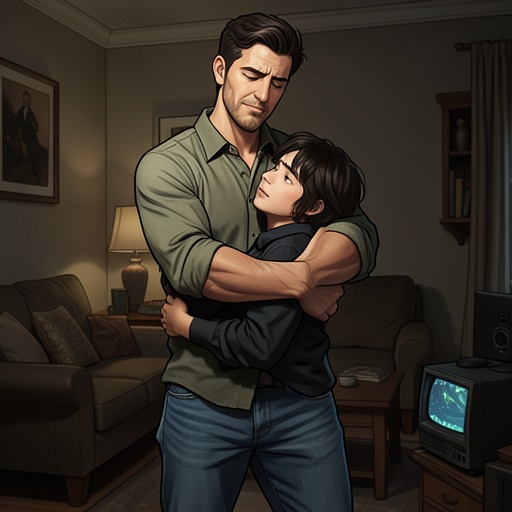
J-Hope’s clearest bond is with Y/N, and it develops through moments in which fear is answered by physical or practical reassurance. After Y/N runs away and encounters hooded men, she recognizes J-Hope among them and admits that she is frightened. J-Hope hugs her and assures her that she does not need to be scared and that he will never hurt her. The gesture matters because it reverses the expectation created by the vampires’ earlier declaration that Y/N is prey: the vampire who could embody the threat instead becomes the character who actively presents himself as a protector.
His care is not limited to words. When Y/N is told to go upstairs, J-Hope offers to walk with her, takes her wrist, and leads her to the stairs and toward the room she must reach. The action is somewhat forceful, since he drags her along rather than simply pointing the way, but it remains framed as guidance through an unfamiliar household. Later, when Y/N says that she would rather not be alone, J-Hope proposes watching a movie after dinner. The suggestion is ordinary and domestic, and its very ordinariness provides a counterpoint to blood, imprisonment, mirrors, and supernatural possession. J-Hope repeatedly creates small forms of companionship inside a world that otherwise makes Y/N feel exposed.
His relationship with Y/N also includes the difficult ethics of restraint. When RM has to be locked in a cage, J-Hope acknowledges that Y/N must feel strange about imprisoning him. Y/N explains that she could not bear seeing him in that condition, and RM places an arm on her shoulder. J-Hope’s presence in this exchange connects him to the household’s attempt to manage vampire danger without abandoning emotional recognition. He understands that confinement can protect others while still wounding the person who carries it out.
Action in the Supernatural Conflict
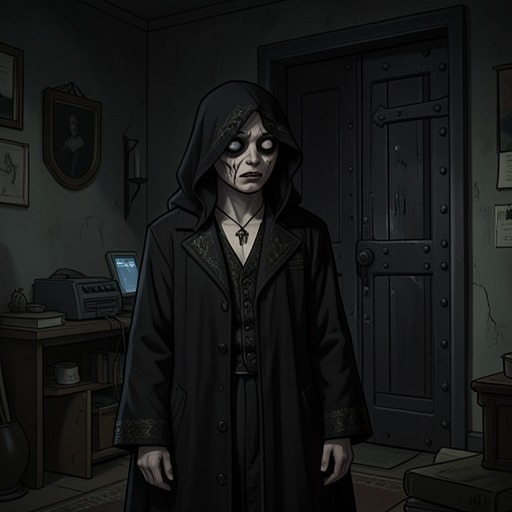
J-Hope becomes an interpreter of the threat posed by the green-eyed beings. After Y/N encounters a figure with green eyes, J-Hope explains that another world exists near their own and that beings there, also resembling vampires, cannot pass through a gate directly. Instead, they sometimes take over the vampires’ bodies while the vampires sleep. This explanation gives Y/N a working model of possession and makes J-Hope a mediator between concealed supernatural knowledge and human uncertainty. He is not merely reacting to the danger; he helps name the structure behind it.
During the effort to escape the Mirror World after Jin has been recovered, J-Hope says that he saw something upstairs that could be used as an exit. His observation turns an otherwise desperate situation into a search for a route outward. The scene also shows his practical orientation: while the group is trapped and uncertain how to fit through the available means of escape, J-Hope contributes concrete reconnaissance rather than abstract reassurance.
His sensory awareness later becomes crucial when the separated group is being pursued. J-Hope suddenly announces that he can smell Y/N, interrupting Leah’s conversation and forcing attention back to the search. The moment is brief but characteristic: his vampire body supplies information unavailable to the human characters, and he uses it to locate the person the group is trying to recover. His supernatural nature, initially a source of danger, thus becomes an instrument of rescue.
J-Hope is also linked to bodily transformation and magical restraint. In the Green-eyed House, Y/N notices a heavy metal chain around his neck; the seal changes into a human form, J-Hope is soaked from swimming, and the chain tightens. The sequence places his body under an external mechanism of control, suggesting that even a protective vampire can become an object of supernatural capture. His identity is consequently unstable in the same way the story’s wider world is unstable: bodies can be possessed, transformed, sealed, or used as passageways between realms.
Loyalty, Fear, and the Group
J-Hope’s protective behavior extends beyond Y/N. When the vampires are imprisoned, the younger members try unsuccessfully to break open the cell, RM searches for a way out, and J-Hope stays close to Suga because J-Hope is terrified. This detail complicates his earlier image of the reassuring protector. He is capable of courage and useful action, but he is not fearless; in confinement, his response to danger is to maintain physical closeness to an ally. The gesture makes loyalty reciprocal rather than heroic in a solitary sense. J-Hope protects others, yet he also needs the stabilizing presence of Suga.
The group’s domestic life provides another register for his character. While Y/N wonders how the others are doing, the vampires argue over a cookie, and Suga wonders whether Hobi has already completed an undertaking. Jin answers that he will succeed. J-Hope is therefore treated by the household as someone whose efforts matter even when he is absent from the immediate scene. The nickname Hobi and the expectation that he will finish what he has begun place him within an intimate group structure rather than presenting him only as a dramatic supernatural figure.
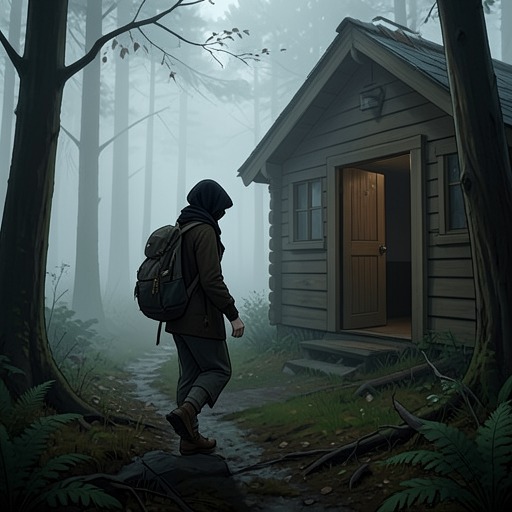
His social role also appears in the unusual refuge associated with the Green-eyed House. Y/N arrives at a small wooden hut surrounded by rocks, and Young-jae nervously calls it their home while admitting that it does not look like much. J-Hope’s connection to the group’s movements through such precarious spaces reinforces the contrast between the formal castle and improvised shelter. He belongs to a community repeatedly forced to redefine home as a place of protection, even when that place is only a hut or a temporary enclosure.
Change and Narrative Significance
J-Hope’s trajectory is marked by repeated movement between danger and care. He is introduced within a household that identifies Y/N as prey, yet he becomes the vampire who hugs her, walks her upstairs, offers ordinary companionship, explains the green-eyed possession threat, searches for exits, detects Y/N’s presence, and remains beside Suga when fear overtakes him. These actions do not make him separate from the vampire world; instead, they show how the story continually negotiates what vampire identity can mean.
His significance lies in this negotiation. J-Hope’s body can be restrained by a tightening chain, his senses can become a means of finding the lost, and his fear can coexist with his willingness to help. He is neither a simple monster nor an invulnerable rescuer. Through him, the narrative repeatedly converts the signs of supernatural danger—vampire instinct, bodily transformation, captivity, and other-worldly passage—into tests of relationship. J-Hope’s decisive function is to keep connection alive when the plot fragments the characters across the castle, the Mirror World, the Green-eyed House, and the prison cell.